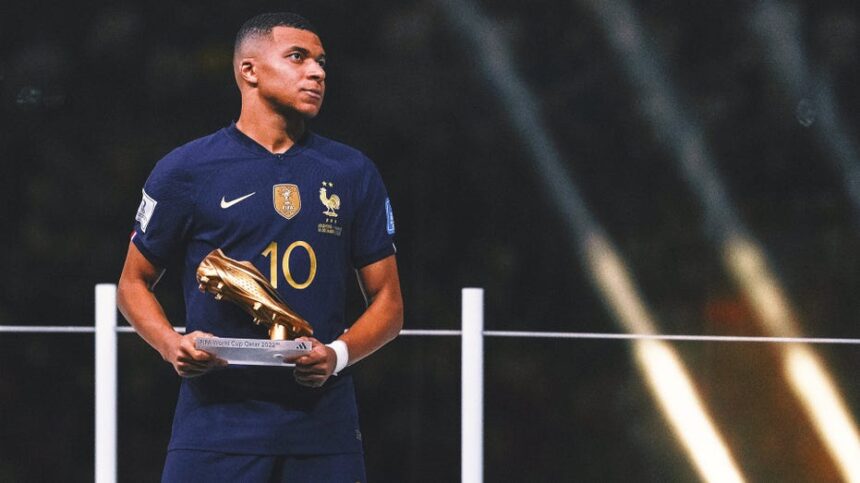
While lifting the trophy is the ultimate goal of every player at every FIFA World Cup, the tournament also presents individual honors that immortalize a player’s personal performance.Â
Among these awards, the Golden Ball recognizes the best overall player and the Golden Glove celebrates the premier goalkeeper, but for the world’s most clinical finishers, the Golden Boot remains the most prestigious individual prize.Â
The Golden Boot was officially inaugurated as the “Golden Shoe” in 1982, though FIFA has retroactively recognized top scorers dating back to the inaugural tournament in 1930.Â
Regardless of the era, each of the following top-goal scorers consistently found the back of the net with the pressure of the entire world watching.
Remarkably, Stábile didn’t even start Argentinas first match, only entering the lineup after a teammate’s injury. He went on to score a hat-trick on his debut and finished the inaugural tournament with eight goals in just four games, including one in the final.
Nejedlý was the creative spark of the Czechoslovakian side that reached the final. While he was credited with only four goals for decades, FIFA officially awarded him a fifth in 2006, confirming his status as the undisputed leading marksman of the Italian tournament.
Nicknamed the “Black Diamond,” Leônidas was a pioneer of the bicycle kick and a true entertainer. He scored seven times in France, including a hat-trick in a chaotic 6â5 win over Poland, though he was controversially rested for the semifinal loss against Italy.
In the first World Cup due to a twelve-year hiatus following the onset of World War II, Ademir delighted the home crowds in Brazil with eight goals. His clinical finishing led Brazil to the final match at the Maracanã, though his individual triumph was overshadowed by losing the title to Uruguay.
As the spearhead of the “Magical Magyars,” Kocsis earned the nickname “The Golden Head” for his incredible aerial ability. He scored 11 goals in just five matchesâincluding two hat-tricksâmaking him the first player to reach double-digit goals in a single tournament.
Just Fontaine set a record in Sweden that will likely never be broken: 13 goals in a single World Cup. What makes it more impressive is that Fontaine played the entire tournament in a pair of borrowed boots after his own had worn out.
The 1962 tournament in Chile and won by Brazil featured the most crowded leaderboard in history. Flórián Albert (Hungary), Valentin Ivanov (USSR), Garrincha (Brazil), Vavá (Brazil; pictured above), Dražan JerkoviÄ (Yugoslavia), and Leonel Sánchez (Chile) all finished with four goals in a tournament defined by its defensive physicality.
The “Black Panther” arrived in England and immediately lived up to his reputation as one of the world’s best. Eusébio scored nine times, including a legendary four-goal performance to rescue Portugal from a 3â0 deficit against North Korea in the quarterfinals.
“Der Bomber” was the ultimate predator, scoring 10 goals in Mexico through sheer instinct and positioning. His tally included back-to-back hat-tricks in the group stage, though his most famous goal was the extra-time winner that knocked out defending champions England.
While the tournament was dominated by the “Total Football” of the Netherlands, it was the rapid Polish winger Grzegorz Lato who topped the charts. He scored seven goals in West Germany, including the winner in the third-place match against Brazil, to secure Polands best-ever finish.
“El Matador” was the heartbeat of Argentinas first World Cup title. After failing to score in the first group stage, Kempes exploded for six goals in the final three games, including two in the final against the Netherlands to send the home crowd into a frenzy.
After starting the tournament slowly following a long suspension, Rossi exploded into life during the second group stage. He famously scored a hat-trick to knock out a leg