
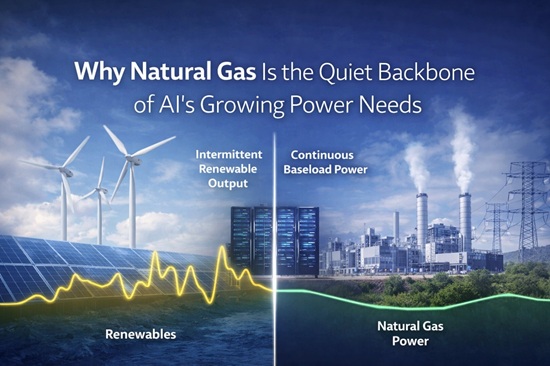
Houston, Texas â Texas Royalty Brokers has released a new research analysis examining how artificial intelligence is reshaping U.S. electricity demand and why natural gas is emerging as a critical near-term source of reliable power as AI infrastructure scales.
The report, Why Natural Gas Is the Quiet Backbone of AIâs Growing Power Needs, focuses on a fast-moving reality. AI-driven data center development is accelerating faster than power generation and transmission projects can be planned, permitted, and constructed. The result is growing reliability pressure in multiple regions and an increasing need for dependable, dispatchable electricity supply.
Artificial intelligence is quickly becoming one of the most power-intensive technologies ever deployed at scale. As large language models, image generation tools, and real-time inference systems expand across industries, the physical infrastructure supporting them, particularly data centers, is creating sustained new demand on U.S. electricity grids.
AI Workloads Create a New Kind of Electricity Demand
Unlike earlier waves of digital growth, AI workloads are continuous and highly sensitive to reliability. Training and inference systems operate around the clock, require stable power delivery, and are often concentrated in specific regions where fiber connectivity, permitting conditions, land availability, and cooling capacity align.
This concentration creates challenges for grid operators. When dozens of facilities cluster in one market, electricity demand can increase in sudden step changes that existing infrastructure was not designed to absorb.
The report emphasizes that AI-driven electricity demand is not simply incremental growth. It differs in intensity, scale, and speed, and those differences are already influencing energy planning and infrastructure decisions.
The Hidden Energy Cost of Artificial Intelligence
Behind every AI system is a physical energy layer that often receives less attention. Data centers supporting AI workloads house high-performance processors that operate continuously.
Facilities designed for AI differ from traditional enterprise or cloud environments. Training advanced models can require thousands of specialized processors running for extended periods. Inference workloads add further demand by requiring constant availability and low latency. Together, these uses create sustained baseload demand rather than variable consumption patterns.
Industry estimates commonly place large AI-focused data centers in the range of tens to hundreds of megawatts of continuous electricity demand. In some regions, clusters of these facilities rival the electricity consumption of mid-sized cities. Unlike many industrial operations that can modulate output, AI systems typically run continuously, making their energy needs more rigid and less flexible.
A key challenge is timing. AI development cycles move far faster than energy infrastructure planning timelines. New power plants, transmission upgrades, interconnection work, and permitting processes often require many years. Data centers can be planned and built far more quickly, creating a widening gap between electricity demand and available supply.
Why AI Power Demand Is Different From Past Technology Waves
Every major technology wave increases electricity demand, but AI is compressing that adjustment period into just a few years.
First is intensity. AI workloads require dense clusters of high-performance processors operating continuously. These systems are not designed to be paused or throttled easily, resulting in sustained high-load demand profiles.
Second is scale. U.S. data center electricity consumption has risen sharply in recent years, with AI accelerating that trend. Historical estimates show data center electricity use growing from roughly 110 terawatt-hours in 2020 to around 180 terawatt-hours by 2024, with usage estimated near 200 terawatt-hours in 2025.
A 2024 analysis from Lawrence Berkeley National Laboratory found that U.S. data centers accounted for approximately 4.4 percent of total U.S. electricity consumption in 2023. The study estimated that data centers could represent between 6.7 percent and 12 percent of total U.S. electricity demand by 2028, depending on the pace of AI-driven infrastructure expansion.
This projected growth is notable for a single category of electricity demand. Once data centers are built, their electricity needs persist, making this demand durable and difficult to defer.
Third is concentration. AI data centers are not evenly distributed across the country. They are built where infrastructure, permitting, and resource availability align, leading to geographic clustering and localized grid stress.
The Grid Reality: Renewables Alone Cannot Meet Baseload Demand
Electricity demand driven by artificial intelligence places unique demands on the power grid, particularly around reliability and continuity. While renewable energy capacity has expanded rapidly, operational characteristics limit wind and solar powerâs ability to meet sustained baseload demand on their own in the near term.
Wind and solar generation is inherently variable and dependent on weather conditions and time of day. Energy storage can help manage short-term variability, but current technologies remain constrained in duration and scale relative to the needs of large, continuous-load facilities.
Transmission presents an additional constraint. Many renewable resources are located far from major data infrastructure and population centers. Expanding transmission capacity involves lengthy permitting processes, significant capital investment, and years of construction.
According to the U.S. Energy Information Administrationâs Short-Term Energy Outlook, U.S. electricity demand is entering one of its strongest multi-year growth periods since 2000. Large computing facilities are identified as a key driver of this increase, placing greater emphasis on reliability and dispatchable generation.
Why Nuclear Is a Long-Term Solution, Not a Near-Term One
Nuclear energy is well suited to meet the reliability requirements of AI-driven electricity demand. Nuclear plants provide continuous, high-capacity baseload power with minimal variability.
However, new nuclear projects face long development timelines due to regulatory approval, financing complexity, and construction requirements. Even optimistic projections place meaningful new nuclear deployment later in the decade, leaving a near-term gap between rising electricity demand and future low-carbon baseload supply.
Natural Gas as the Bridge Fuel for the AI Era
Natural gas is positioned to fill this gap. Gas-fired power plants can operate continuously, ramp output quickly, and integrate with existing grid infrastructure. Compared to nuclear projects or major transmission expansions, natural gas facilities can often be planned, permitted, and constructed more quickly.
As AI continues to reshape electricity demand, natural gas is carrying a disproportionate share of incremental load. Its role is less visible than the technologies it supports, but it remains central to maintaining grid stability during a period of rapid structural change.
The Overlooked Upstream Impact
AI-driven electricity demand also carries upstream implications. Sustained natural gas demand can influence development timelines, capital allocation, and production planning. For mineral owners tied to natural gas resources, AI-driven demand represents a potential structural shift rather than a short-term pricing event.
Looking Ahead
The growth of artificial intelligence is reshaping electricity demand in ways that extend beyond technology markets. As data centers expand, energy systems must adapt to steady baseline growth combined with rapidly increasing, always-on demand. Texas Royalty Brokersâ analysis is intended to help stakeholders understand why grid constraints are emerging, how planning timelines shape fuel choices, and why natural gas is playing an increasingly important near-term role.
About Texas Royalty Brokers
Texas Royalty Brokers is an independent mineral rights brokerage based in Texas, providing educational resources and transaction support for mineral owners across the United States.
Contact Information:
Business: Texas Royalty Brokers
Contact Name:Â Eric Winegar
Email: eric@texasroyaltybrokers.com
Website: https://texasroyaltybrokers.com/
Country:Â United States