
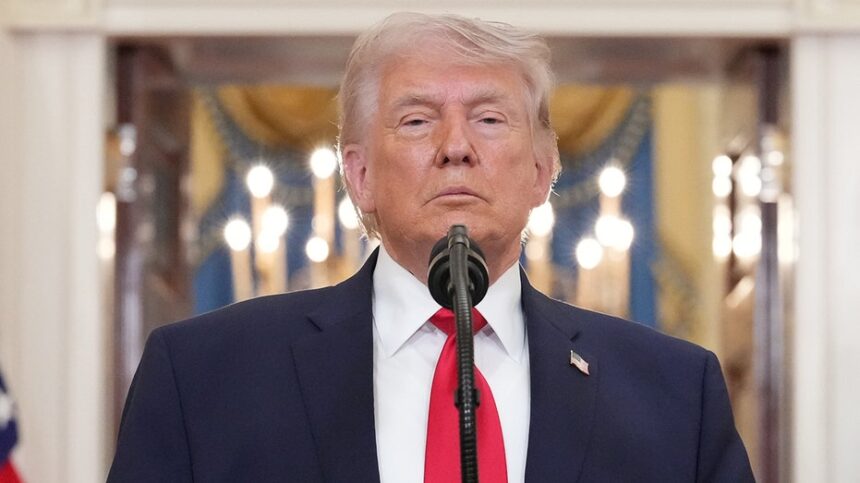
President says the war with Iran is “nearing completion,” but a looming deadline could determine whether the conflict is actually ending â or about to escalate.
“We are going to finish the job, and were going to finish it very fast. Were getting very close,” Trump said Wednesday night, adding that U.S. forces will “hit them extremely hard over the next two to three weeks” and “bring them back to the Stone Ages, where they belong.”
As the war enters what analysts describe as its final phase, the administration is signaling a shift from broad military gains to a narrower endgame â raising questions about what “finishing the job” actually means militarily and politically.
Trump gave Iran until Tuesday to reopen the Strait of Hormuz, warning that failure to comply could trigger sweeping strikes on the countrys energy infrastructure.
“If no deal is made ⦠we are going to hit each and every one of their electric-generating plants, very hard and probably simultaneously,” he said.
“With a little more time, we can easily OPEN THE HORMUZ STRAIT, TAKE THE OIL, & MAKE A FORTUNE. IT WOULD BE A “GUSHER” FOR THE WORLD???” he said on Truth Social Friday.Â
The U.S. already has begun to include major infrastructure. This week, American strikes hit one of Irans largest bridges â a critical transportation artery â signaling that mixed-use infrastructure supporting military logistics is now firmly on the table.
“The biggest bridge in Iran comes tumbling down, never to be used again â Much more to follow!” Trump wrote on Truth Social. “IT IS TIME FOR IRAN TO MAKE A DEAL BEFORE IT IS TOO LATE.”
That raises a central question heading into the final weeks: what, exactly, would “finishing the job” look like?
Military analysts say it is unlikely to be a single decisive strike. Instead, the endgame may unfold as a series of escalating options â from intensified attacks on Irans remaining missile and drone network, to broader strikes on infrastructure designed to force the regime into a deal, or a longer-term strategy of containing Irans capabilities from above.
“We will continue to see very aggressive attrition of offensive and defensive targets, as well as infrastructure targets,” said RP Newman, a retired Marine ground combat veteran and counterterrorism consultant.
Some critics doubted that Trump has a clear exit strategy.Â
Trump’s public address Wednesday “was a summary, somewhat in chronological order, of things hes already said on social media for the last month â and that, in and of itself, reveals that he doesnt have a plan,” said Trita Parsi, a geopolitical analyst with the Quincy Institute, on X. “I think he wants to get out of this war. I just dont think he knows how.”
Rather than winding down, Newman said, the U.S. may still be expanding its options. “That gives the President more options and it gives the enemy an additional problem set to ponder.”
He also cautioned that Iran retains significant capability despite weeks of strikes.
“Iran likely has more missiles and drones remaining in their inventory than some people in organizations think or are claiming,” Newman said.
Recent U.S. intelligence assessments cited by CNN suggest that roughly half of Irans missile launchers remain intact and thousands of drones are still in its arsenal.
Behnam Taleblu, a senior fellow at the Foundation for Defense of Democracies, said the likely objective now is to “degrade and defang the regime of its long-range strike capabilities and prevent it from being able to pose a threat abroad.”
That effort, he said, would focus not just on weapons, but on the systems that sustain them.
“The that house these missiles and drones need to be targeted and collapsed ⦠as well as the domestic supply chain and defense industrial base that supports these projectiles,” Taleblu said.
At the same time, the administration appears to be signaling limits to how far it will g