
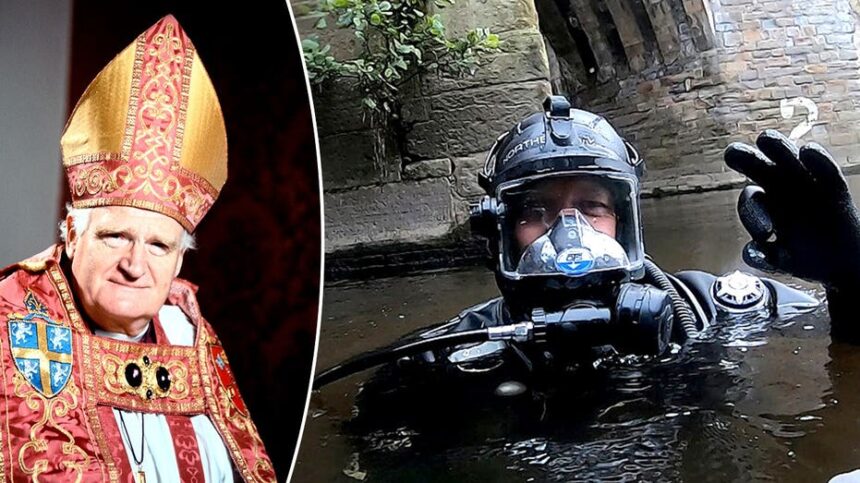
An archaeologist uncovered a cache of deliberately thrown in an English river â and has now shed light on why they were dumped.
Gary Bankhead, an archaeologist at Durham University, has found a variety of valuable Christian artifacts in the River Wear in Durham.
The artifacts included a bronze crucifix, a silver trowel and a christening spoon, as well as a silver key, a 19th-century Russian icon depicting and a silver medal from 1964 showing Christ with open arms, surrounded by Greek letters in a Byzantine-style font.
Other significant finds included gold, silver and bronze medals commemorating the Second Vatican Council, as well as a gold Greek Orthodox cross pendant and other medals, including one marking the coronation of .
Bankhead has linked the hoard to Michael Ramsey, an English bishop who served as the Archbishop of Canterbury from 1961 to 1974 and later retired to Durham.
Its “exceptionally unusual” to find a in a river, said Bankhead â especially one linked to the head of the Church of England.
Bankhead told Fox News Digital he’s spent “many years” diving the River Wear and has recovered over 14,500 artifacts from the river in total.Â
Still, to him, the Ramsey hoard “immediately stood apart.”
He uncovered the hoard nearly two decades ago, but recently detailed the , “Pilgrim Souvenirs, Devotional and other Objects of Faith: Late-medieval to modern period small finds from the River Wear, Durham.”
“What made it so striking was the way the objects had been deposited,” he said. “They werent scattered randomly across the riverbed.”
Instead, Bankhead found “distinct clusters” beneath Prebends Bridge, one of
The archaeologist noted it looked “as though someone had stood above the bridge and deliberately dropped them into the water” â hinting at what was to come.
Bankhead spent the next two years recovering the hoard. Once he’d recorded each object, he found that a clear pattern emerged.
He found that Ramsey’s housekeeper, Audrey Heaton, removed the artifacts at the instruction of Joan Ramsey, the bishop’s wife, as the pattern did not suggest a crime.
Bankhead said his explanation “only really came together” when he spoke with the niece of Heaton, who shared Heatons diaries and memories of her aunt.
He determined that Joan Ramsey packaged small groups of objects into plastic bags and weighed them down with stones to ensure they sank â though the exact reason remains unclear. Bankhead suggested the items may have been discarded because they could not be sold or given away.
The niece told Bankhead that she recalled her aunt being “extremely upset” about being asked to throw the religious items in the river.
“She recognized that they had real historical and monetary value, and struggled with the idea of throwing them away,” said Bankhead.
“This wasn’t something Heaton ever forgot. It weighed heavily on her, which is why she talked about it whenever they met.”
The disposal process was covert, and Heaton was tasked with disposing of the bags while walking her dogs early in the morning or late at night.
“She was instructed to ensure that no one saw what she was doing,” Bankhead said.
He added, “The objects were not randomly dispersed. Items relating to Greek Orthodoxy were found together in one location, Vatican-associated objects in another, with the remaining material arranged in distinct clusters beneath the four different bridge abutments.”
Bankhead said he’s never seen himself “as a treasure hunter in the commercial sense.”
“When the hoard was formally valued, I donated my share to the Help for Heroes charity, because making any personal financial gain from it never felt appropriate,” he said.
“My interest has always been in the history and the story â not the monetary value.”
Bankhead noted that had its own story, with each one carefully created by skilled artis