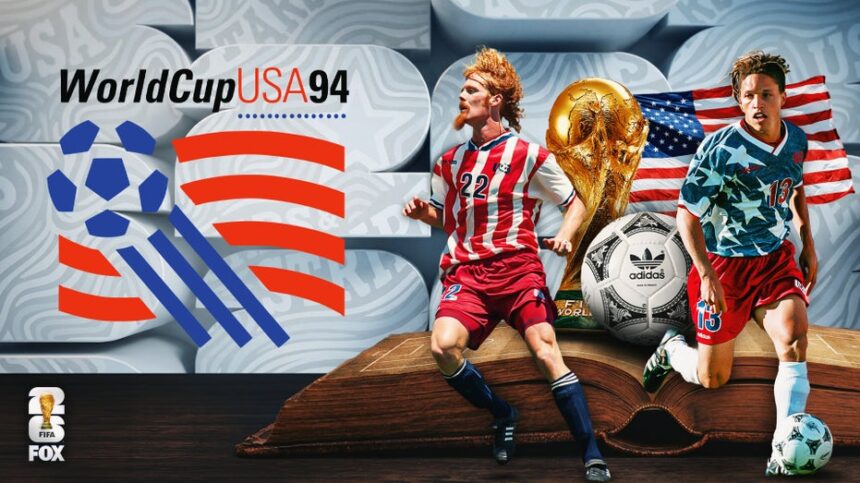
In 1994, the United States proved global critics wrong as hosts of the World Cup.
Skeptics in Europe and South America argued that a country without a top-tier professional league, paired with a population that supposedly didn’t “understand” the game, was a questionable choice for the worlds biggest sporting event.
But what unfolded over the course of the summer was a memorable tournament witnessed by massive crowds at stadiums that were known more for the other kind of football. American soccer had its long-awaited defining moment.
Let’s take a look back on the summer of soccer took over the United States.
If you remember or have seen clips of the U.S. men’s national team at the 1994 World Cup, a couple of things stood out. One was the amazing hairstyles. You had Alexi Lalas. Cobi Jones. Marcelo Balboa. Tony Meola. All American soccer icons rocking such a unique blend of looks.
Building on its appearance at the 1990 World Cup in Italy, in which it went winless in three games, the USA wanted to ensure that it would make a better impression as hosts.
The United States men’s national team opened the group stage against Switzerland at the Pontiac Silverdome â then home to the NFL’s Detroit Lions â on a temporary grass pitch.Â
The first match in World Cup history to be played indoors, the stadium had been designed to keep the winter weather out and was not equipped with air conditioning. USA midfielder Thomas Dooley later called it “the worst place I have ever played at.”
But it was thanks to a wonder-goal against the Swiss by the USA star Eric Wynalda that made the game memorable, even if the game ended in a 1-1 draw.Â
After splitting points in the opener against Switzerland, the U.S. stunned a heavily favored Colombia team in a 2â1 victory at the Rose Bowl. But that followed a 1-0 loss in the same stadium to group winners Romania, thus relegating the U.S. to a third-place finish in the group and a Round of 16 date with Brazil. Â
On a sunny July 4 afternoon, the USA took on mighty Brazil at Stanford Stadium in Palo Alto. A rough and tumble match that saw the Brazilians play part of the match a man down due to a red card, the USA couldn’t break down the more talented South American squad. Brazil ended the Americans’ dream with a 1â0 victory.Â
Brazil went on to lift the countrys fourth World Cup by defeating Italy, breaking a 24-year drought and its first championship since Pelé last lifted his third and final trophy of his illustrious career in 1970.
Brazil were led by legendary strikers Romario and Bebeto, who finished with a combined eight goals. It was Bebeto who scored the game-winner against the USA in the Round of 16. A quarterfinal win over the Dutch then set up a semifinal victory over Sweden, in which Romario scored the decider.Â
Despite the historic setting at the Rose Bowl, the final itself had relatively few memorable moments. After 120 minutes of scoreless play, it became the first World Cup final to be decided on penalties.Â
If there was a lasting image of the final, it would be Italy star Roberto Baggio sailing over the crossbar his penalty attempt over the crossbar and into the crowd. Heartbreak for the Italys, but an elusive fourth title for Brazil.Â
The tournament provided its fair share of legendary players. It was the last tournament where we saw players like Diego Maradona, who had helped Argentina win it all in 1986, and Germany icon Jürgen Klinsmann, who led his country to the 1990 title.
But Maradona’s abrupt exit from the World Cup would prove to be one of the most shocking moments in World Cup history. After one final iconic goal and a wild-eyed celebration against Greece, he was sent home in disgrace after failing a drug test.Â
Just days after Maradonas exit, Russias Oleg Salenko etched his name into the record books in a way no one saw coming. Â
In a group stage match against Cameroon at Stanford Stadium, Salenko s