
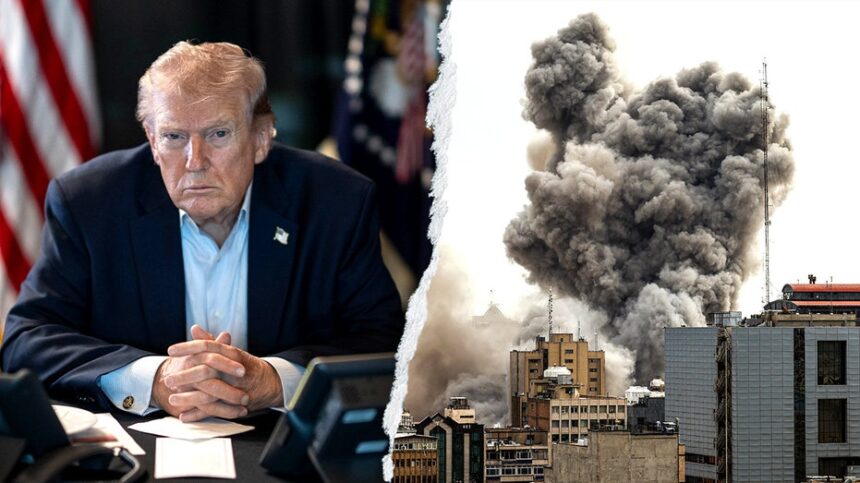
“Our stockpiles of defensive and offensive weapons allow us to sustain this campaign as long as we need to,” Secretary of War said at U.S. Central Command headquarters on Thursday.
From a tactical perspective, the scale of the airstrikes unleashed in Operation Epic Fury indicates that the U.S. almost waited too long. Starting Irans ballistic missiles and drones required strikes on almost 2,000 aimpoints in just the first few days. Thats one munition per aimpoint, and there could be thousands more to go.
It was now or never. Iran planned to stockpile missiles and drones and build a handful of nuclear weapons that no military force could reach. “Iranian negotiators said to us directly, with no shame, that they controlled 460 kilograms of 60% and theyre aware that that could make 11 ,” U.S. Special Envoy Steve Witkoff said Tuesday.Â
The terrifying scale of Irans target set went unnoticed by most of the world until last Saturday.
Imagine how difficult this job would have been in a few years â especially with Russia and China helping Iran restock.
“This operation needed to happen because Iran, in about a year or a year and a half, would cross the line of immunity, meaning they would have so many short-range missiles, so many drones that no one could do anything about it because they could hold the whole world hostage,” Rubio said on Capitol Hill on Monday. “Look at the damage theyre doing now. And this is a weakened Iran ⦠imagine a year from now,” he added.
With Irans command and control degraded and air defenses flattened, the southern air ingress approaches to the country are wide open. “And now, with , we will be using 500-pound, 1,000-pound and 2,000-pound GPS–and laser-guided precision gravity bombs, of which we have a nearly unlimited stockpile,” Hegseth said at the Pentagon on Wednesday.
Here come the big bombs to take on hundreds of targets. Those targets include factories, weapons storage sites and every IRGC facility U.S. forces can find. And its all happening while a 2,000-mile arc of aerial defense continues.
The U.S. is not running out of bombs for Operation Epic Fury. Here are seven systems seeing heavy action:
Joint Direct Attack Munition: JDAMs use to hit precise coordinates. The combat-proven JDAM family of munitions is actually a kit. You take a Mk 82 500-pound free-fall gravity bomb, a Mk 83 1,000-pound bomb body or a Mk 84 2,000-pound bomb body, then attach a precision seeker and a tail kit with steering fins just before missions. Military munitions specialists â sometimes called AMMO troops â build the bombs before loading them onto the aircraft. In the Navy, for example, you can spot ordnance loaders on an aircraft carrier deck by their red jerseys. In 2003, U.S. fighter and bomber crews dropped 5,086 of the 2,000-pound GBU-31 JDAMs in Operation Iraqi Freedom. So yes, planners knew to stock up. A new wing kit doubled the range for the JDAM Extended Range variant. JDAMs can attack “off-axis,” meaning behind or to the side of the fighter or bomber.
GBU-39 Small Diameter Bomb: Combining precision with powerful explosives, the Small Diameter Bomb weighs 250 pounds and has a remarkable 40-nautical-mile range when launched, along with the ability to strike moving vehicles. The bomb body is advanced, with a more powerful but compact explosive that limits collateral damage. Aircrews can change coordinates in flight for this GPS-guided munition. F-22 Raptors can drop SDBs while flying supersonic.
Patriot and THAAD: U.S. forces are leading the defense against missile and drone threats. Patriot remains the gold standard for terminal-phase intercepts, and Hegseth noted inventories were in good shape. THAAD â Defense â is also widely used.
Air-to-air missiles: For drones, there are many options, starting with fighter aircraft armed with AMRAAMs (Advanced Medium-Range Air-to